DuckDuckGo Proxy Guide: Private Search, Testing, and SERP Checks
A DuckDuckGo proxy can help you search from another network location, separate research traffic, and compare search results without using your normal IP address.
DuckDuckGo is privacy-focused, but a proxy still has practical uses. It can help with regional research, repeated search testing, and keeping browser experiments separate from everyday browsing.
DuckDuckGo proxy: What This Guide Helps You Decide
If you are searching for DuckDuckGo proxy, you probably need more than a definition. You need to know when this proxy setup makes sense, what type to choose, how to test it, and what problems to avoid before you use it for SEO, scraping, browsing, accounts, or automation.
This guide also answers the close follow-up questions people usually have around proxy DuckDuckGo, private search proxy, search engine proxy, and SERP proxy, so the article is useful even when the exact search phrase is slightly different.
Last reviewed: June 2026. The guidance focuses on practical proxy selection, setup testing, measurement, and responsible use rather than search-engine tricks.
Short Answer
DuckDuckGo proxy is a decision topic. Choose based on the real job: speed, compatibility, account risk, privacy, cost, protocol support, and how the setup behaves on the actual website or tool.
Fast Facts
| Decision point | Best-practice answer |
|---|---|
| Best fit | DuckDuckGo proxy helps buyers choose the right routing tool, protocol, privacy level, or proxy type for the job. |
| First test | Compare options against the real website, app, account workflow, or reporting task before buying at scale. |
| Avoid when | Do not choose based only on the name of the technology or the cheapest price. |
| Measure success | Track compatibility, speed, reliability, account risk, cost, and support quality. |
Topic Map
| Entity | How it fits this guide |
|---|---|
| Main topic | DuckDuckGo proxy |
| Proxy role | Helps compare routing options, protocols, privacy levels, and proxy types for a specific workflow. |
| Related concepts | proxy DuckDuckGo, private search proxy, search engine proxy, and SERP proxy |
| Search intent | The reader wants to choose between options without buying the wrong tool. |
| Main caution | Do not treat a proxy as a guarantee; test the real workflow and respect website rules. |
Related Terms in Plain English
- proxy DuckDuckGo: A decision factor to compare by speed, cost, compatibility, privacy, reliability, and real workflow fit.
- private search proxy: A decision factor to compare by speed, cost, compatibility, privacy, reliability, and real workflow fit.
- search engine proxy: A decision factor to compare by speed, cost, compatibility, privacy, reliability, and real workflow fit.
- SERP proxy: A data or SEO workflow where location control, request pacing, and clean error handling matter.
Questions Answered in This Article
| Reader question | What this article answers |
|---|---|
| What should I know before choosing DuckDuckGo proxy? | Which proxy type, location, protocol, and stability level fit the practical use case. |
| What should I know before choosing proxy DuckDuckGo? | Which proxy type, location, protocol, and stability level fit the practical use case. |
| What should I know before choosing private search proxy? | Which proxy type, location, protocol, and stability level fit the practical use case. |
| What should I know before choosing search engine proxy? | Which proxy type, location, protocol, and stability level fit the practical use case. |
| How do I get cleaner SEO or data results? | How to collect data or check rankings with better location control, cleaner testing, and fewer blocks. |
How to Use This Information
- Match the proxy to the job: browser access, scraping, SEO checks, account workflows, and developer tools all need slightly different setups.
- Check location and protocol first: confirm the visible IP, HTTP or SOCKS support, authentication, and speed before scaling.
- Measure results: track success rate, response time, blocks, challenges, and repeatability instead of judging the proxy from one test.
- Avoid low-quality shortcuts: free or unknown proxies can create privacy, reliability, and account-trust problems.
Useful Internal and External Links
Use these links to check the proxy setup, compare related guides, and confirm technical or policy details from official sources.
Related BuyProxies resources
- Proxy tester
- IP location checker
- Proxy formatter
- HTTP vs SOCKS proxies
- Proxy vs VPN comparison
- Shared vs private proxies
Official references
Quick Answer
A DuckDuckGo proxy can help you search from another network location, separate research traffic, and compare search results without using your normal IP address. The practical goal is to make the setup stable, measurable, and easy to debug instead of relying on guesswork.
Who This Helps Most
DuckDuckGo Proxy Guide is for buyers who are trying to avoid the wrong tool for the job. The best choice depends on what you need to protect, what software you use, and how much speed, trust, privacy, or compatibility matters.
Use this guide as a decision page. Do not choose a proxy type because the name sounds stronger. Choose the option that fits the workflow, then test it against the real site or tool before scaling.
Best Uses for a DuckDuckGo Proxy
- Checking search results from another country or network.
- Keeping research sessions separate from normal browsing.
- Testing SERP changes while using clean browser profiles.
- Comparing privacy workflows with proxy and VPN setups.
- Running light search research without overusing one IP.
Real-World Examples
Here are practical ways this guidance shows up in real work:
- Buying decision: A buyer compares cost, speed, privacy, compatibility, and account risk before choosing the proxy type.
- Tool fit: A developer checks whether the software needs HTTP, SOCKS, browser-level settings, or device-level routing.
- Risk review: A team chooses the lower-risk option for accounts and the faster option for low-risk testing.
- Scaling plan: A project starts with a small sample, measures results, and only then buys a larger proxy pool.
Best Proxy Setup for This Job
| Setup choice | Best fit | Watch out for |
|---|---|---|
| Fast private datacenter proxy | Speed, cost control, scraping, QA, and SEO checks | Some platforms score datacenter IPs more strictly. |
| Residential proxy | Higher-trust browsing and sensitive account contexts | Higher cost and less predictable speed. |
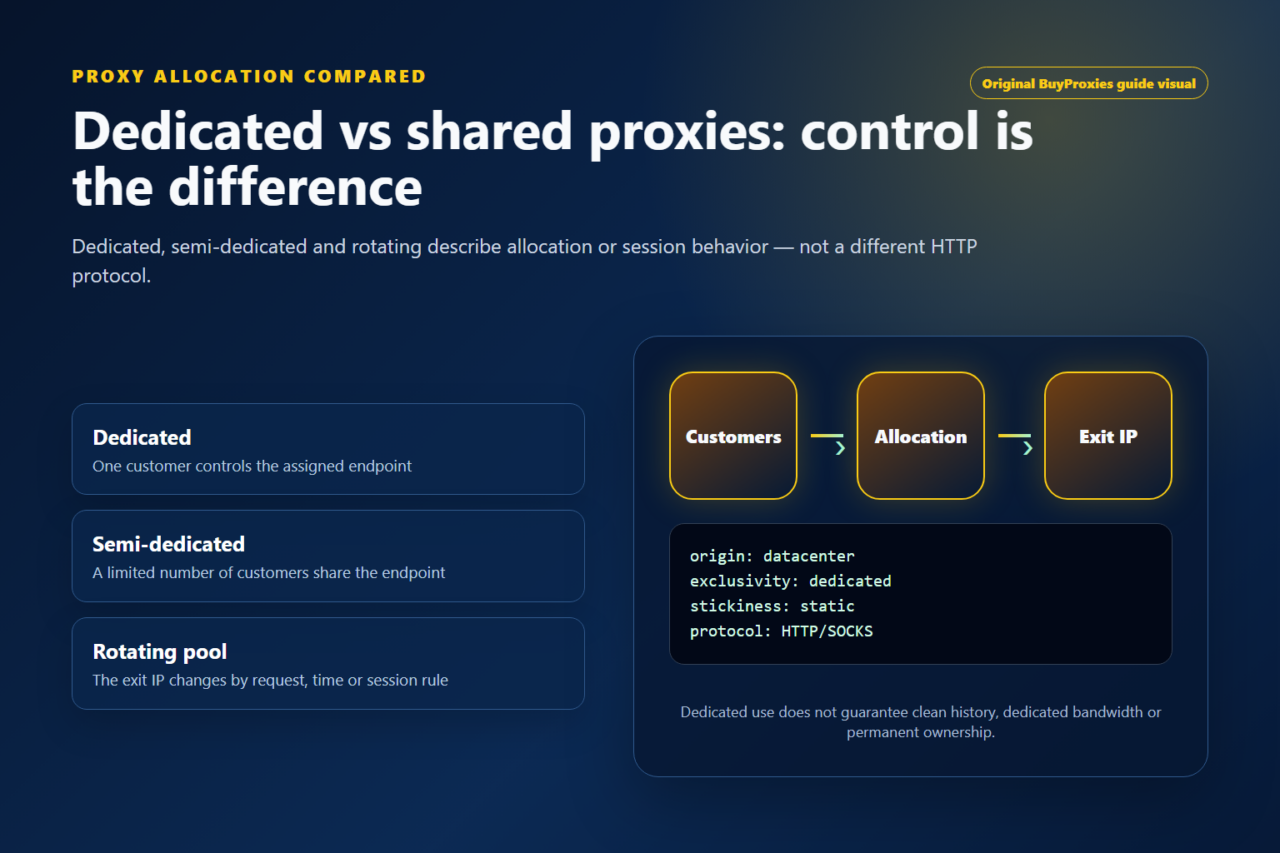
| Shared proxy | Budget-sensitive, low-risk tasks | Less control over reputation and performance. |
| VPN or device-level tunnel | Broad personal routing for one device | Less granular than per-tool proxies. |
Practical Scenario
The best comparison is not theoretical. Pick the two or three proxy types that could fit, test them against the same site or tool, then compare speed, failure rate, compatibility, account risk, and support. The right answer is the setup that works reliably for your real workflow.
Practical Decision Check
| Question | Best next step | Proof to look for |
|---|---|---|
| What job must the proxy do? | Write down the exact tool, target site, country, volume, and risk level. | The proxy type is chosen for a workflow, not because the label sounds stronger. |
| Which option fails least? | Test each proxy type on the same small sample. | You have side-by-side data for speed, blocks, compatibility, and support. |
| What is the real cost? | Include replacements, downtime, failed jobs, and support quality. | The cheapest plan is not chosen if it wastes operator time. |
| Can you scale safely? | Increase traffic or accounts gradually after the first test passes. | Failure patterns are understood before the project gets larger. |
What Good Results Look Like
- Each option is tested against the same real target, not judged from a feature list alone.
- Speed, success rate, compatibility, support, and total cost are compared together.
- The final choice fits the tool, risk level, and expected volume.
- The team can explain why a cheaper or more expensive option was rejected.
- Scaling begins only after a small test produces stable results.
How to Choose a Proxy for DuckDuckGo
Use stable proxies for repeatable search testing. If you change IPs constantly, it becomes harder to know whether results changed because of location, timing, or your own setup.
- Use a clean browser profile for SERP comparisons.
- Choose country-specific proxies for regional checks.
- Avoid public free proxies for privacy-sensitive research.
- Test visible IP before collecting results.
- Keep cookies and proxy location consistent during one test.
What to Check Before You Start
| Check | Why it matters |
|---|---|
| Proxy location | The visible IP should match the country, market, or route your task needs. |
| Protocol support | Your browser, script, or software must support the proxy type you bought. |
| Authentication | Wrong usernames, passwords, ports, or allowlisted IPs are common causes of failed setups. |
| Real target test | The only useful comparison is against the site, app, or account workflow you actually use. |
| Total cost | Consider replacements, support, failures, and time lost, not just monthly price. |
DuckDuckGo Proxy Testing Workflow
- Choose the country or proxy pool you want to test.
- Open a clean browser profile.
- Enable the proxy and confirm the IP.
- Run the same search set consistently.
- Record location, date, browser, and proxy used.
How to Measure Success
A good proxy setup should produce fewer surprises over time. Track simple signals so you can tell whether the proxy is helping or whether the real issue is the website, account, tool, or request pattern.
- Success rate: how many requests, checks, or sessions complete without errors.
- Response time: whether the proxy is fast enough for the workflow.
- Block or challenge rate: how often websites show captchas, login checks, or access errors.
- Location accuracy: whether the visible IP matches the market you are testing.
- Repeatability: whether the same setup gives similar results tomorrow.
Common Mistakes to Avoid
- Comparing results while cookies and locations keep changing.
- Running automated searches too quickly.
- Using an unknown proxy for private research.
- Assuming a proxy removes every browser tracking signal.
- Ignoring language and region settings.
Red Flags to Watch For
- The choice is made from the proxy type name instead of a real test.
- Only monthly price is compared, while failure time and support are ignored.
- VPNs, forward proxies, reverse proxies, and residential proxies are treated as interchangeable.
- No one checks whether the target software supports the required protocol.
- The team buys a large pool before testing a small sample.
Troubleshooting
| Problem | What to try first |
|---|---|
| The proxy does not connect | Check host, port, protocol, username, password, and whether your IP must be allowlisted. |
| The location looks wrong | Test the IP with a location checker and request a replacement if the country is not right. |
| Everything is slow | Lower thread count, test another proxy, and compare against a simple IP-check page. |
| Accounts get challenged | Stabilize browser profile, location, device settings, and activity pace before changing more IPs. |
| Scraping gets blocked | Slow down requests, add backoff, rotate carefully, and separate proxy errors from target-site blocks. |
When You Should Not Use This Setup
Do not use proxies to break laws, bypass rules you agreed to, spam platforms, fake engagement, overload websites, or hide activity that would put accounts or users at risk. A proxy is a routing tool, not a permission slip.
Related Guides and References
Related BuyProxies guides
- Google proxies
- Proxy vs VPN
- Why free proxies are bad
- Proxy tester
- Proxy formatter
- IP location checker
Helpful external references
DuckDuckGo Proxy FAQ
Does a proxy make DuckDuckGo fully anonymous?
No. It changes IP visibility, but cookies, browser fingerprints, and behavior can still create signals.
Can DuckDuckGo block proxy traffic?
Any search engine can limit unusual traffic. Keep testing reasonable and avoid repetitive automation.
Should I use a proxy or VPN for search privacy?
A proxy gives tool-level control. A VPN is broader device-level routing. Choose based on scope.