United States proxy guide
USA Proxies: Private US IPs for Regional Testing
USA proxies route a permitted workflow through a United States datacenter exit. They are useful when the location of the network request must be controlled and documented, but the exit country is only one part of a reliable test.
What a USA proxy changes
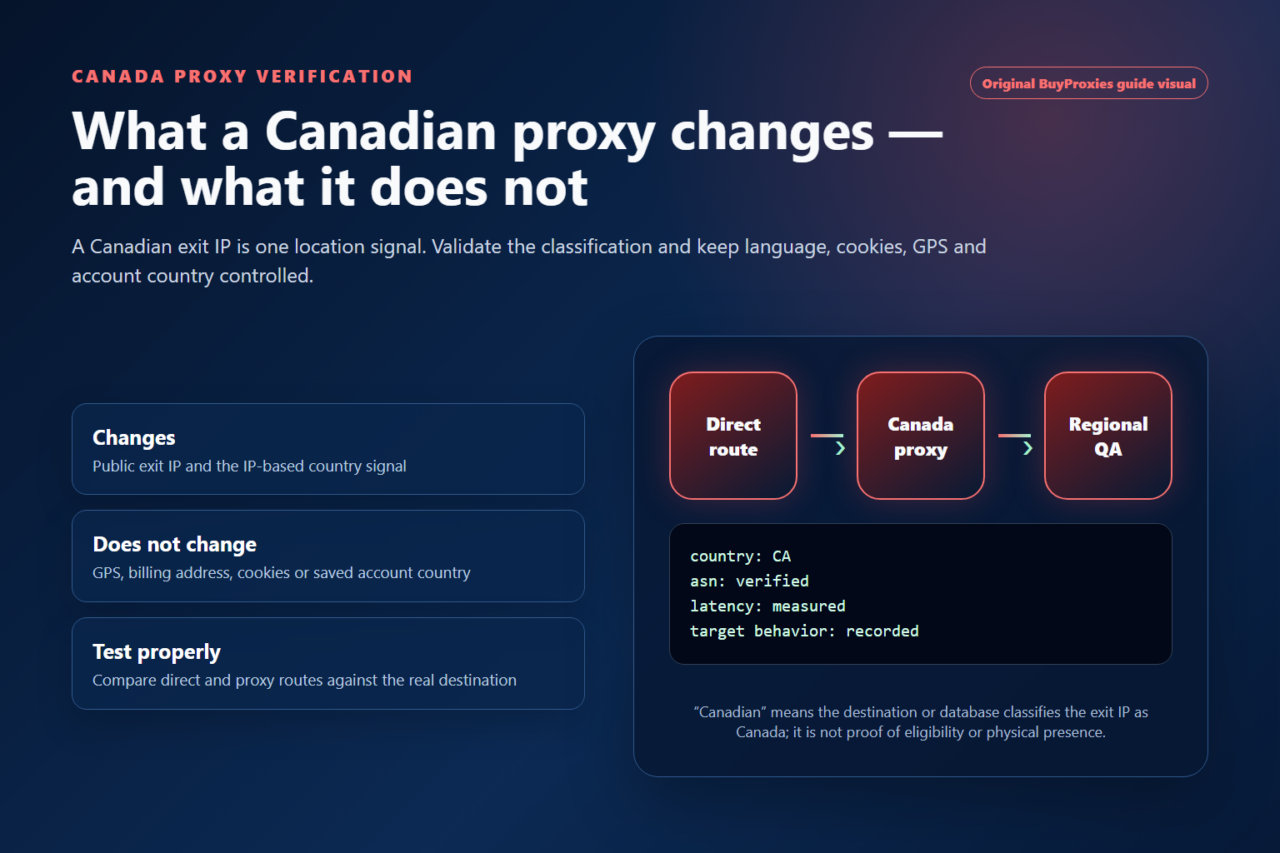
A USA proxy replaces the public network route used for the connection. The destination normally sees the proxy IP, its datacenter network and an approximate United States location instead of the direct connection. It does not change the operating system, browser language, timezone, cookies, account history or application permissions. Those signals can still influence search results, advertisements, prices and personalized pages. A useful regional QA plan therefore treats the US exit as one controlled variable and records every other setting that could change the result. This makes a comparison repeatable instead of assuming that every difference came from the IP address.
Good uses for private US IPs
Common uses include checking US landing pages, validating regional redirects, reviewing public advertising placements, monitoring local search results, testing an API from a US route and reproducing a customer connectivity issue. Development teams can keep a staging or monitoring job on a predictable address. SEO teams can compare a named search query from the same city-level configuration over time, while respecting the target service rules. Public-data research should remain within applicable law, published rate limits and access policies. A proxy supplies the route; the operator remains responsible for the request volume, the data collected and the way accounts are authorized.
Dedicated or semi-dedicated assignment
Dedicated proxies are assigned to one customer and are the clearer choice for a persistent browser profile, authenticated application, recurring monitor or workflow where IP history matters. Semi-dedicated proxies have a lower entry cost and can suit lower-risk public checks or development tests, but a small number of customers share the assignment pool. Start with the sensitivity of the task rather than package size. If the session contains login state or must remain consistent for weeks, prefer a dedicated assignment. If the job is a short public availability check, a semi-dedicated option may be sufficient after reputation and target compatibility are verified.
Location accuracy and latency
An IP database can label the same address differently because geolocation providers update on different schedules. Verify the US exit with more than one source when state or city interpretation matters, and record the ASN as well as the country. Then measure latency to the actual target, not only to a generic speed-test server. A route that is fast to one coast can be slower to infrastructure on the other side of the country. Keep a baseline from the direct connection, test several requests at normal volume and separate DNS, connection, TLS and application time when diagnosing a slow result.
Authentication and protocol choice
BuyProxies plans support username and password or IP-based authorization, with HTTP, SOCKS5 and UDP options shown during configuration. Username authentication is convenient for changing client networks. IP authorization can simplify a server job with a stable outbound address. HTTP is straightforward for web clients that explicitly support a proxy. SOCKS5 is useful when the application needs a more general transport route. Confirm the required combination in the order form, store credentials outside source code and test with the same application that will run the real workflow.
How to interpret a failed test
A successful IP check proves that the proxy route is active; it does not prove that every destination accepts the request. If a target fails, classify the problem before replacing anything. A 407 response points to authentication. A timeout can indicate routing, firewall or target delay. A 403 or 429 can be specific to target policy or request rate. Compare the result with a second public endpoint, verify the proxy format and test a single request without extensions. Preserve the timestamp, status code and proxy identifier so support can investigate a reproducible case.
Choose the setup around the task
| Workflow | Starting point | Verification |
|---|---|---|
| Regional website QA | Dedicated or semi-dedicated US proxy | Confirm redirect, language, currency and visible US exit. |
| Recurring SEO or ad check | Dedicated US proxy | Keep query, browser state, schedule and location evidence consistent. |
| Server-side API test | Dedicated proxy with IP authorization | Allowlist the server address and log status, latency and request ID. |
Verification workflow
- Define the US-specific result that should be observable before selecting a package.
- Choose dedicated or semi-dedicated assignment based on session sensitivity and duration.
- Configure the supported protocol and authentication method in the actual client.
- Verify the exit country, ASN and target compatibility before collecting evidence.
- Record status, latency, timestamp and expected versus actual behavior, then scale gradually.
Important limitations
- An IP location cannot override account history, cookies, language or device settings.
- City-level geolocation can vary between databases and should be independently checked.
- A working proxy does not grant permission to collect data or automate a destination.
- Target-specific blocks and rate limits require diagnosis, not uncontrolled IP changes.
Start with a controlled test
Start with one documented United States test and a small proxy package. Verify the US exit, authentication and target behavior first; expand only after the result is stable and the operating rules are clear.
Plan a USA proxy workflow
Check fit before choosing a package
Good fit
Local search checks, advertising previews, ecommerce QA and recurring US browser sessions.
Verify before scaling
Confirm the visible US exit and target behavior; a country assignment does not guarantee a specific city.
Order clarity
What you receive
- What you receive
Proxy connection details for the package processed through the live order form.
- Protocols
HTTP or SOCKS5 options are shown during configuration for supported packages.
- Authentication
Set the requested proxy credentials during configuration before checkout.
- Locations
Current location availability is shown in the selector and can change with inventory.
- Support and checking
Support can help verify connection details and review replacement requests under the service policy.