Australian proxy guide
Australia Proxies: Buy Private Australian IPs
Australia proxies route permitted requests through Australian datacenter IPs for regional QA, local search checks, advertisement review, pricing research and compatible data workflows. Compare dedicated and semi-dedicated plans, then verify current Australian availability, the visible exit country, compatibility and latency against your real destination before scaling.
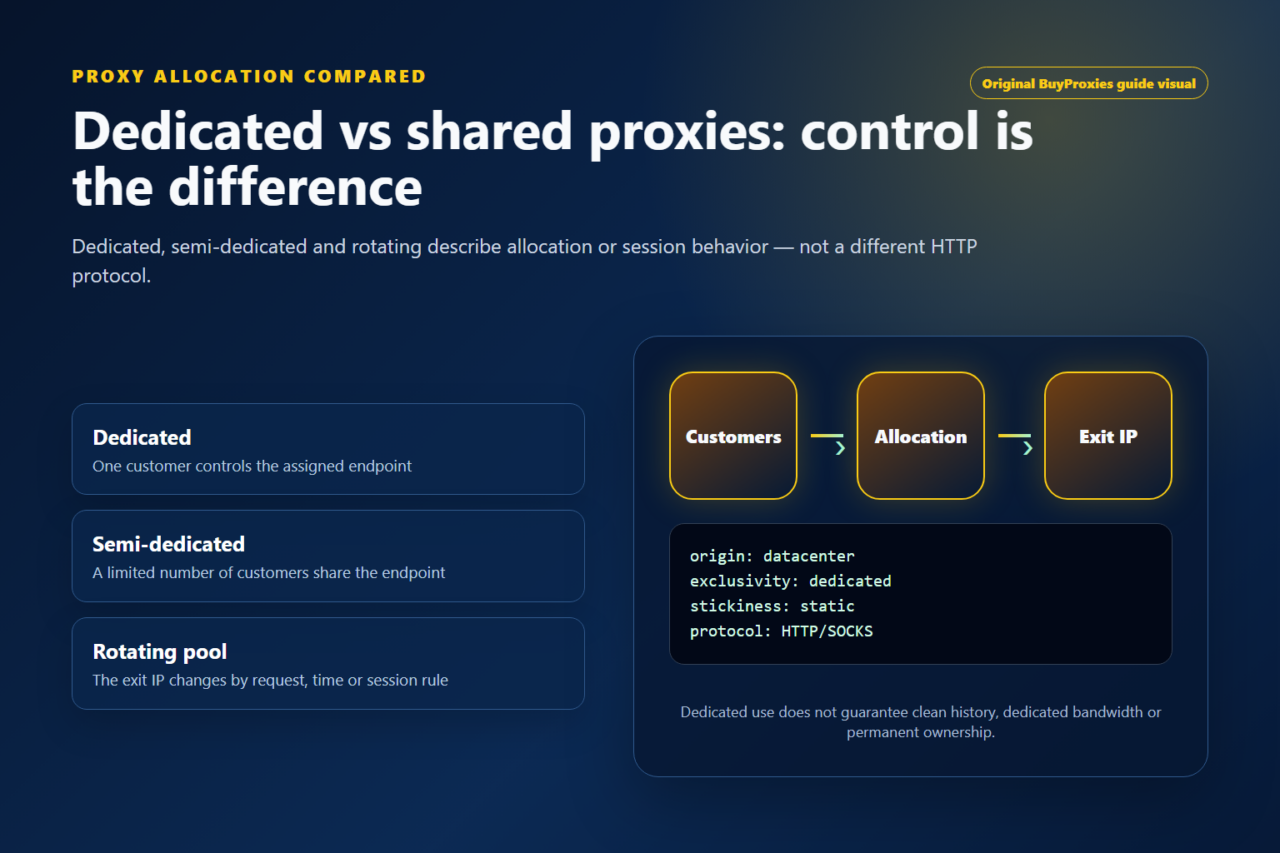
Dedicated vs semi-dedicated Australia proxies
| Plan | IP use | Best starting point | Check before buying |
|---|---|---|---|
| Dedicated | Assigned to one customer | Stable sessions, repeatable QA and workflows that benefit from consistent IP ownership | Current Australia stock, target compatibility and measured latency |
| Semi-dedicated | Shared by a limited number of customers | Lower-cost browsing, research and workloads that tolerate shared IP reputation | Current Australia stock, target compatibility and observed success rate |
Check the live dedicated proxy plans and semi-dedicated proxy plans; the store is the source of truth for availability.
How to evaluate an Australian route
| Check | What to verify | Why it matters |
|---|---|---|
| Location | Confirm the public exit IP resolves to Australia using more than one lookup when the result matters. | IP databases can disagree or lag behind routing changes. |
| Latency | Run repeated tests from your real client to a representative destination. | Distance, routing and the destination affect results more than a country label alone. |
| Compatibility | Test the same protocol, authentication method and permitted destination used in production. | A successful generic IP check does not prove application compatibility. |
| Stability | Compare median latency, tail latency, timeouts and successful responses over a useful sample. | A single fast request can hide intermittent failures. |
Use the proxy region speed test, review IP locations, and follow the proxy location guide before committing a larger workload.
What an Australia proxy can verify
An Australian proxy changes the public IP and approximate network location presented to a destination. This can help a team review localized pages, region-specific redirects, public product information, search results, advertising creatives and application behavior from an Australian route. It cannot force a website to show a particular result because language, cookies, account settings, inventory and personalization may also apply. Write the expected outcome before testing and capture the URL, timestamp, proxy identifier and visible exit. When the result differs, repeat the same request with a documented baseline rather than changing several variables at once.
Australian workflows that benefit from a stable route
Regional QA is strongest when a named page or application state is checked from the same type of connection over time. Local SEO teams can monitor a defined set of queries, while ecommerce and advertising teams can validate public landing pages, redirects and currency presentation. Developers can reproduce connectivity reports from Australian users or confirm that a CDN and API are reachable from the region. These activities should use normal request rates and authorized access. A private proxy is infrastructure for the test, not permission to ignore a destination policy or collect information that the operator is not entitled to use.
Plan selection for long-distance connections
Australia can be geographically distant from a target server, so consistency and latency deserve more attention than headline bandwidth. Use a dedicated assignment for an authenticated browser, persistent monitor or recurring client workflow. A semi-dedicated assignment can suit public checks where lower cost matters more than exclusive history. Test the smallest useful package from the network where the application will run. If the operator is in Europe or North America, the round trip to an Australian exit and then to the destination can be materially longer than a local route. That is expected physics, not automatically a proxy fault.
Measure latency in the correct context
Measure DNS, connection, TLS and application response where possible. A generic ping result does not describe an authenticated HTTPS page, API call or browser session. Test several normal requests to the actual destination and report the median rather than selecting the fastest single sample. Check whether delays occur before the proxy connection, between the proxy and target or inside the application. If an Australian exit is required for evidence, do not switch to a nearer country simply to improve the number; instead choose a target server, schedule or client location that keeps the required regional route practical.
Verify location, ASN and protocol
Confirm the Australian exit with an independent IP location checker and review the ASN and network owner. Databases can disagree at state or city level, so the country result and the destination behavior should be recorded separately. Configure the protocol supported by the real client: HTTP for explicit web proxy support, SOCKS5 for applications that need a general proxy transport, or UDP where the selected plan and application support it. Use username credentials when the source network changes, or IP authorization for a server with a stable outbound address. Never place proxy passwords in screenshots or public logs.
Troubleshoot without losing the evidence
If a site does not show Australian content, first verify that traffic is using the proxy. Then check account country, language, cookies, timezone and whether the site localizes at all. A 407 response is an authentication problem. A timeout may come from the long route, firewall rules or target delay. A 403 or 429 is a target response that should be reviewed against request behavior and policy. Save the exact error, timestamp and a small reproduction. Repeatedly changing proxies can erase the evidence needed to tell whether the cause is network, configuration or application logic.
Choose the setup around the task
| Workflow | Starting point | Verification |
|---|---|---|
| Australian localization review | Stable dedicated or semi-dedicated exit | Verify country, language, redirect and target page. |
| Long-running monitor | Dedicated Australian proxy | Measure median latency and keep the route consistent. |
| Development reproduction | Small test package | Use the affected protocol and capture the complete error timeline. |
Verification workflow
- State the Australian behavior being checked and the evidence needed to confirm it.
- Select assignment type, protocol and authentication for the actual client.
- Verify the Australian exit and record the ASN before opening the target.
- Measure several normal requests and compare them with a documented baseline.
- Keep account, language, cookies and device settings stable while interpreting the result.
Important limitations
- Long geographic routes can add latency even when the proxy is operating normally.
- Australian IP databases may disagree about state or city information.
- Personalized sites can use account and browser signals in addition to the exit country.
- A proxy does not change legal, contractual or platform access requirements.
Australia proxy FAQ
Do Australia proxies guarantee city-level location?
No. IP databases can disagree about state or city. Verify the Australian country result and the exact target behavior before relying on a location label.
Why can Australia proxies feel slower from Europe or North America?
The route may travel to an Australian exit before reaching the destination, so distance can add latency even when the proxy is working normally.
Should I choose dedicated Australia proxies?
Choose dedicated Australia proxies for authenticated sessions, recurring monitors, client QA and workflows where assignment history matters.
Start with a controlled test
Use an Australian proxy when the route is necessary for a defined regional check. Validate the exit and latency with the real destination, preserve the rest of the test context and increase capacity only after the workflow is repeatable.
Plan a Australia proxy workflow
Check fit before choosing a package
Good fit
Australian regional QA, pricing research, advertising previews and local search checks.
Verify before scaling
Measure latency from the real client location and confirm the Australian exit before scaling the list.
Order clarity
What you receive
- What you receive
Proxy connection details for the package processed through the live order form.
- Protocols
HTTP or SOCKS5 options are shown during configuration for supported packages.
- Authentication
Set the requested proxy credentials during configuration before checkout.
- Locations
Current location availability is shown in the selector and can change with inventory.
- Support and checking
Support can help verify connection details and review replacement requests under the service policy.
Turn an Australian endpoint into a repeatable check
Confirm current Australian availability before ordering. Once an endpoint is delivered, verify its visible exit country separately from authentication, then repeat a small permitted request in the intended application. A configuration generator cannot establish stock, geolocation or destination compatibility.