
United Kingdom datacenter proxy guide
UK Proxies: Buy Private United Kingdom IPs
UK proxies provide a United Kingdom public IP for approved regional testing, local search checks, monitoring and compatible business tools. The useful question is not simply whether an address is labelled UK. It is whether the assignment is private enough for the job, authenticates reliably, stays in the expected country and works with the actual application. This guide explains how to compare UK datacenter proxies, test an endpoint before scaling and avoid promises that a network route cannot make.
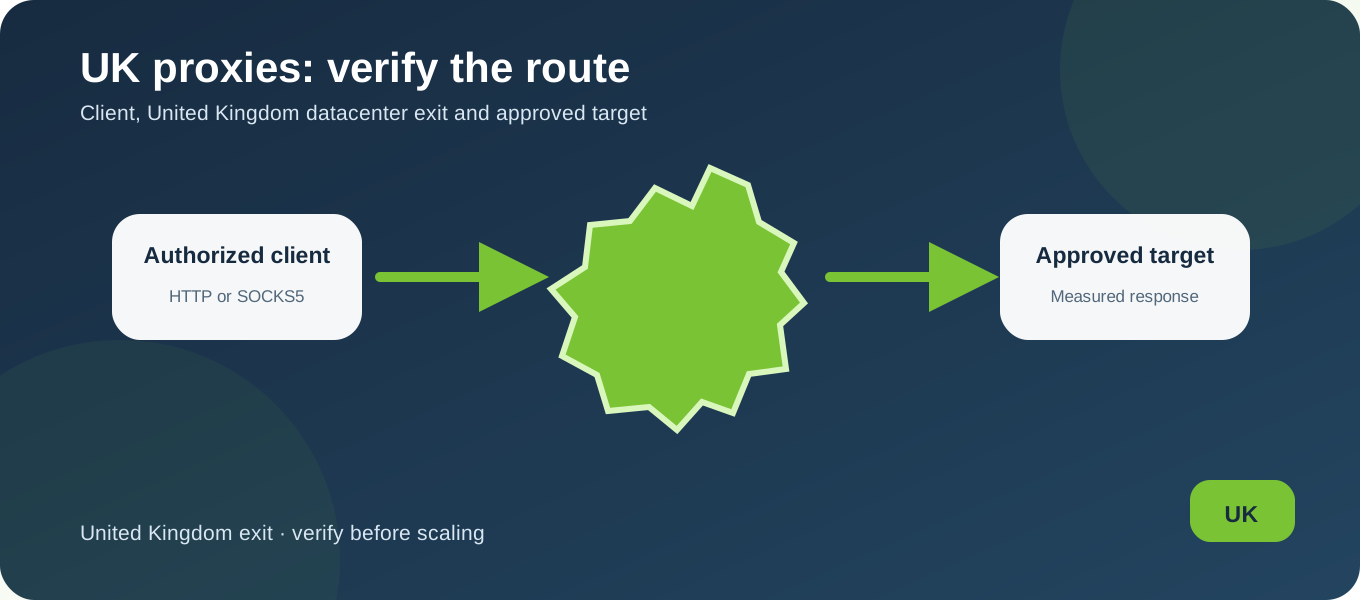
Quick answer
What should you know before ordering?
Choose UK proxies when an authorized workflow needs a consistent United Kingdom network location and the predictable endpoints of datacenter infrastructure. Confirm current availability in the live store, select dedicated or semi-dedicated access based on reputation control, verify the visible exit country and test the real destination. A UK proxy changes the public network route; it does not guarantee account approval, precise city placement or compatibility with every website.
What a UK proxy changes
A UK proxy receives a request from your browser or software and sends it onward from a United Kingdom network address. The destination normally sees the proxy exit IP rather than the original public IP. That can help a team review country-level search results, verify localized pages, test advertisements, monitor availability or run a permitted data workflow from a consistent network location. The proxy does not change account history, browser cookies, device settings, language, billing country or application rules. It also does not turn an unauthorized task into an authorized one. Treat the IP route as one controlled variable in a documented test. When the result matters, record the endpoint, protocol, visible exit address, country result, target and timestamp so another operator can reproduce the observation.
Dedicated and semi-dedicated UK proxies solve different problems
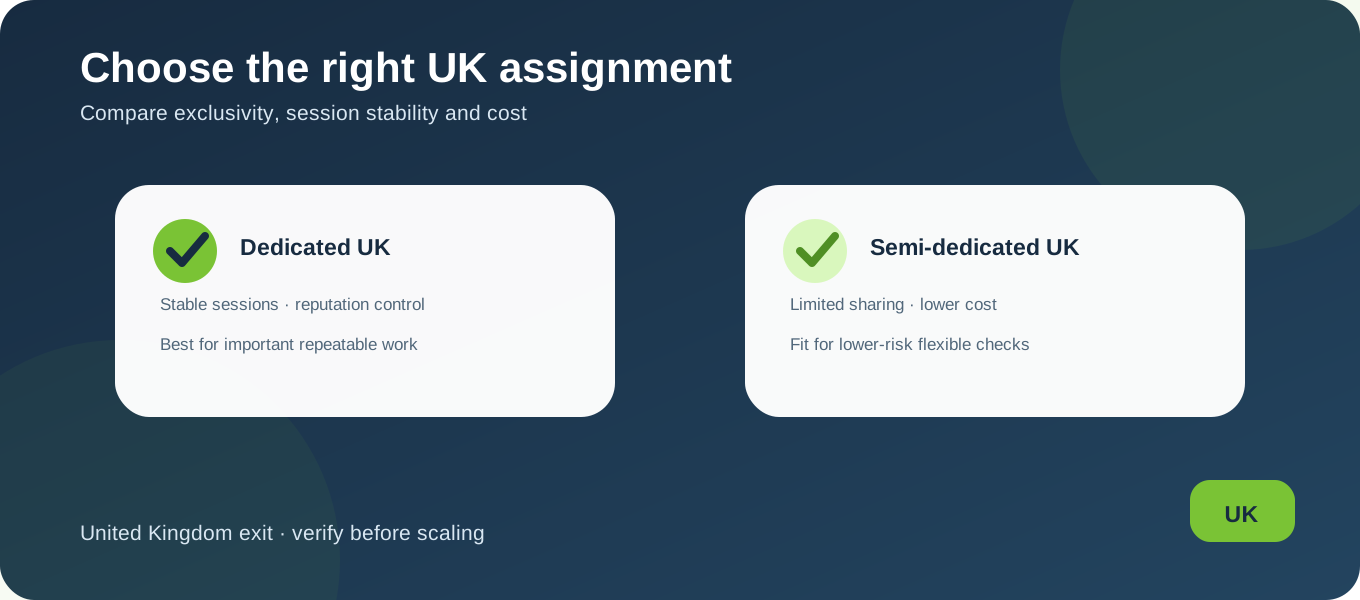
A dedicated assignment gives one customer control of an IP during the service period. It is the stronger choice when session continuity, reputation isolation and predictable reuse matter. A semi-dedicated assignment is shared by a limited number of customers and can reduce cost for workflows that tolerate some shared reputation. Neither label describes the target application policy or guarantees that a particular destination will accept the route. Compare the cost of the plan with the cost of a failed workflow. Important logins, long-running sessions and sensitive monitoring usually benefit from dedicated control. Short-lived research or broader low-risk checks may fit a semi-dedicated plan. Confirm the current sharing model and package details in the store because availability and plan composition can change.
Country verification is more reliable than a city promise
IP geolocation is an estimate maintained by third-party databases. Country results are generally more useful for a UK regional workflow than a precise city pin, and two providers can temporarily disagree after address space is moved or updated. Registration data, routing and geolocation are related but separate facts. RIPE IPmap explains that its engines use several techniques to guess possible infrastructure locations, which is why a result should be treated as evidence with uncertainty rather than GPS. Test the assigned public IP in more than one source, then check the application that actually matters. If the target classifies the route incorrectly, preserve the evidence and ask which correction source it uses. Do not scale a project from a package label alone.
HTTP and SOCKS5 support depends on the client
For browser and ordinary web traffic, an HTTP proxy is often the simplest choice. HTTPS destinations commonly use the HTTP CONNECT method to establish a tunnel through the proxy; RFC 9110 defines how that request identifies the destination host and port. SOCKS5 is useful when an application explicitly supports SOCKS or needs a more general proxy interface. The protocol selected in the customer panel must match the protocol configured in the client. A SOCKS endpoint entered as HTTP can look offline even when the service is healthy. Before importing a complete list, test one endpoint with the exact browser, scraper, SEO tool or script that will be used in production. Save a known-good configuration as the control for later troubleshooting.
Authentication should be stable and narrowly handled
Proxy access commonly uses a username and password or an authorized client IP. Store credentials outside source code, screenshots, support tickets and public logs. If the password contains reserved characters, use the encoding rules expected by the client rather than changing the credential at random. A 407 response usually means the proxy received the request but requires valid authentication. A timeout points to a different stage and should not be diagnosed as a password error. Test DNS behavior, IPv4 and IPv6 routing, connection time and the visible exit separately. The UK address should appear only after the proxy route is active. If the original IP remains visible, another extension, VPN, system setting or application route may be bypassing the proxy.
Test the real destination before buying at scale
A generic IP checker proves that the proxy can connect to that checker; it does not prove that the endpoint works with a different target. Begin with one approved destination and a conservative request rate. Confirm the response content, not only the status code, because a block page can still return HTTP 200. Record authentication errors, connection timeouts, TLS failures, rate limits and application denials as different outcomes. Repeat a small sample over a realistic interval to observe stability. If a workflow needs a fixed IP, make sure the same endpoint produces the same exit address across the complete session. Scaling a list before these checks multiplies configuration mistakes and makes it harder to distinguish a proxy issue from a target or client issue.
Choose a package from operational requirements
Write down the number of concurrent sessions, required country, protocol, authentication method, reuse period and target compatibility before comparing packages. More IPs do not automatically improve a poorly designed workflow. A small set of stable dedicated UK proxies can be more useful than a larger shared pool when sessions must remain consistent. Conversely, a low-risk QA task may not justify maximum exclusivity. Current location inventory and package availability must be checked in the live selector. BuyProxies supplies datacenter assignments, and the service does not guarantee a particular city, consumer ISP identity or acceptance by every destination. Choose the smallest plan that passes the real test, monitor it and expand only with measured evidence.
Operate UK proxies responsibly
Use proxies only where you have authorization and follow the destination terms, robots controls, rate limits and applicable law. A proxy is not a substitute for consent, account permissions or data minimization. Keep request rates proportionate, identify failures before retrying and stop when the application signals that traffic should slow down. The UK National Cyber Security Centre advises treating networks as untrusted and applying appropriate controls and monitoring. For a proxy workflow, that means protecting credentials, limiting who can use the list, maintaining logs without secrets, patching client systems and reviewing unexpected destinations. A stable operational process protects both the project and the reputation of the assigned addresses.
Buying workflow
A repeatable selection and testing process
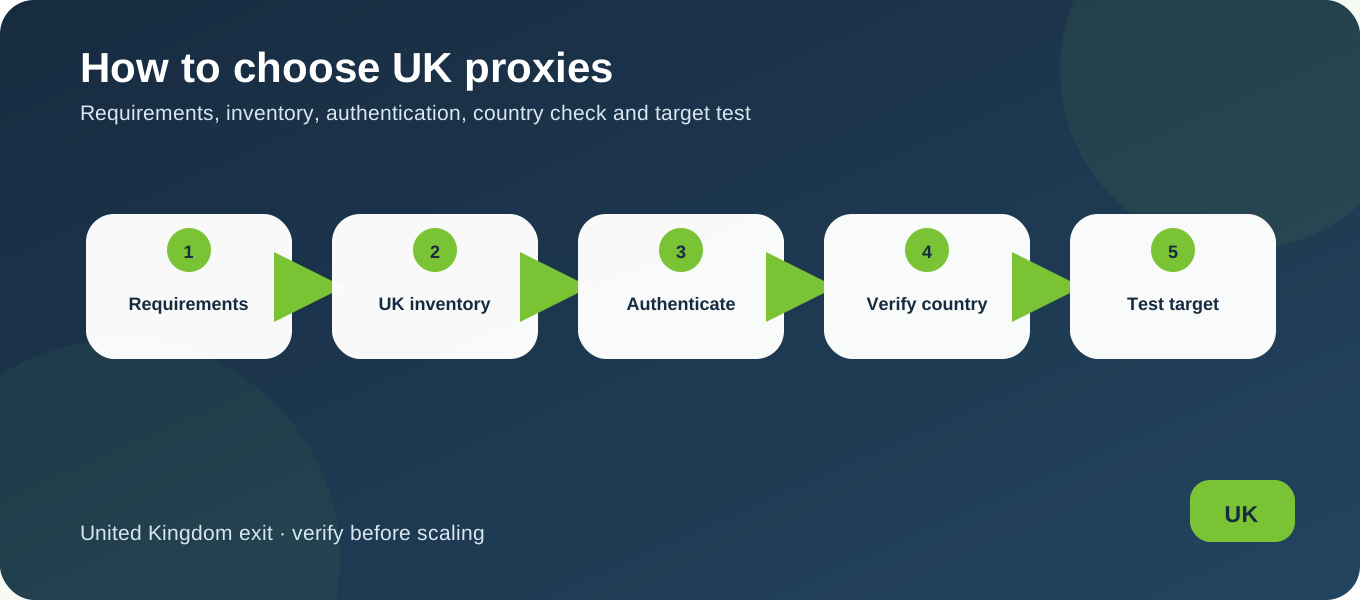
- Define the approved task, required UK country signal, protocol and session duration.
- Check current UK availability and package details in the live store.
- Choose dedicated control or limited sharing according to the workflow risk.
- Configure one endpoint with the exact authentication and protocol the client expects.
- Verify the public exit IP and country with independent location checks.
- Test the real destination at a conservative rate and inspect response content.
- Record the endpoint, timestamp, target and result before expanding the package.
Compare the practical choices
| Choice | Operational fit |
|---|---|
| Dedicated assignment | Best for stable sessions and isolated reputation; costs more than a limited shared plan. |
| Semi-dedicated assignment | Useful for lower-risk workloads that tolerate limited sharing and prioritize cost. |
| HTTP proxy | Straightforward for browsers and web-oriented tools when the client expects HTTP proxying. |
| SOCKS5 proxy | Use when the application explicitly supports SOCKS5 or requires its broader interface. |
| Country verification | Confirms the current visible UK exit; it does not prove an exact city or future target acceptance. |
Related BuyProxies resources
Frequently asked questions
UK Proxies: Buy Private United Kingdom IPs FAQ
What are UK proxies?
They are proxy endpoints whose public exit IP is classified in the United Kingdom. Verify the assigned exit before relying on it for a regional workflow.
Can I buy dedicated UK proxies?
Choose the dedicated package and check current UK inventory in the live selector. Location availability can change, so the store is the authoritative source for the order.
Do UK proxies guarantee a London IP?
No. A country-level UK assignment does not guarantee a specific city, and geolocation providers can disagree. Test the actual IP and target.
Should I choose HTTP or SOCKS5?
Use the protocol supported by your application. HTTP is often simpler for web traffic; SOCKS5 is appropriate when the client explicitly supports it.
Will a UK proxy work on every website?
No. A proxy changes the network route but does not guarantee target compatibility, account approval or exemption from application rules.
Choose from evidence
Start small, verify, then scale
The best UK proxy package is the one that passes a documented real-world test. Match the sharing model and protocol to the task, verify the visible United Kingdom exit, protect authentication and start with a small plan. Current availability belongs in the live store, while location and compatibility must be confirmed on the assigned endpoint. That approach avoids vague promises and produces a route the team can measure and support.
Plan a UK proxy workflow
Check fit before choosing a package
Good fit
United Kingdom search, localization, ecommerce and advertising verification workflows.
Verify before scaling
Confirm the UK exit and target behavior; a UK assignment does not guarantee a London IP.
Order clarity
What you receive
- What you receive
Proxy connection details for the package processed through the live order form.
- Protocols
HTTP or SOCKS5 options are shown during configuration for supported packages.
- Authentication
Set the requested proxy credentials during configuration before checkout.
- Locations
Current location availability is shown in the selector and can change with inventory.
- Support and checking
Support can help verify connection details and review replacement requests under the service policy.