France proxy guide
France Proxies: Private French IPs for Localization
A France proxy routes a compatible browser or application through a French exit IP; it does not automatically change browser language, cookies or account country. Compare private datacenter packages for localization, SEO checks, advertising review or development, then request France in the live order form and confirm availability. Verify the assigned exit country before relying on a location-dependent result.
What a France proxy changes
A France proxy changes the public IP and route visible to a website or application. The destination can normally identify a French exit and its network owner rather than the operator connection. This can be one useful localization signal, but it does not automatically change browser language, cookies, account country, delivery availability or personalization. A rigorous test records those inputs and holds them constant while the route changes. Capture the final URL, timestamp and visible country so another person can repeat the comparison. This is more reliable than assuming that a French IP alone controls every regional decision.
Localization, SEO and advertising workflows
A controlled French route can help review public French landing pages, language redirects, local search results, advertising destinations, pricing presentation and CDN availability. Developers can reproduce connection reports from France or verify a permitted API integration from a stable address. SEO and advertising tests should use named queries, pages and expected outcomes instead of broad browsing. Public-data collection must respect destination rules, rate limits and applicable data requirements. If an authenticated account is required, use an approved account with normal multifactor and recovery controls. The proxy changes the network path but does not grant additional account privileges.
Choose assignment by session sensitivity
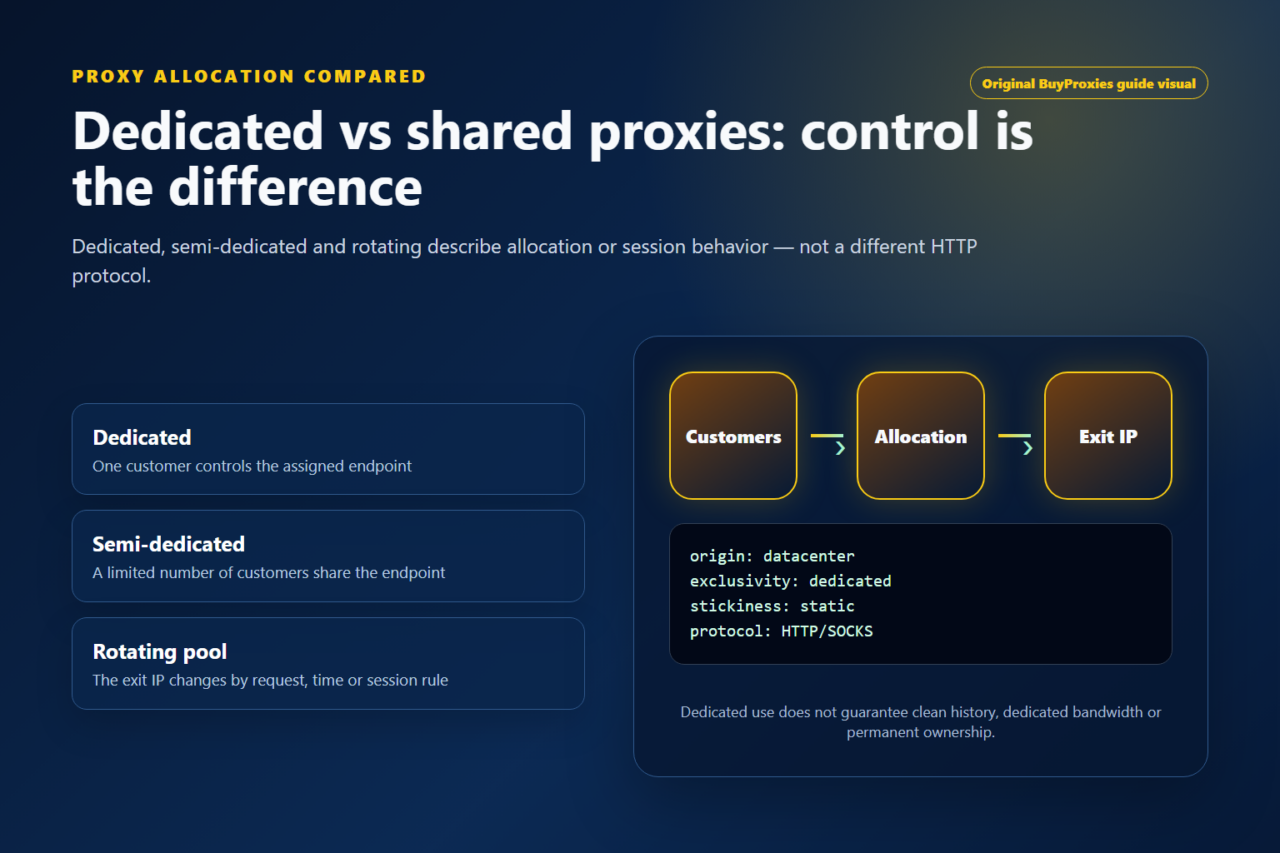
A dedicated French proxy is easier to reason about for an authenticated session, persistent browser profile, recurring monitor or client workflow because one customer controls the assignment. Semi-dedicated service can suit public localization checks or development tests where lower cost is important and exclusive history is not required. Select the smallest package that can reproduce the task. Confirm that the application supports the protocol and authentication shown in the order form. A successful small test is stronger evidence than buying additional addresses before location, latency and target behavior have been verified.
French language and consent signals
French pages may depend on Accept-Language, consent cookies, account preferences and campaign parameters in addition to IP location. For a clean public comparison, create a documented browser profile, select the intended language and note the initial consent state. Do not clear or alter these settings halfway through the run. When checking an advertisement or redirect, record the source URL, parameters and final destination. If the result remains in another language, inspect site localization controls before replacing the proxy. The objective is to isolate the cause, not merely obtain a different page.
Authentication, protocol and secret handling
HTTP proxies fit clients with explicit web proxy support. SOCKS5 is useful for software that needs a broader proxy transport, while UDP support depends on the selected plan and application. Username and password authorization works for operators whose source address changes. IP authorization is practical for a stable server. Keep credentials out of content management systems, screenshots, analytics and source repositories. Verify the French exit with a separate checker before opening the target. Then run one controlled request and save the status, timing and proxy identifier without publishing sensitive values.
Troubleshoot French route results
Separate network health from destination behavior. First verify connectivity and the French exit. Next check the exact target response. A 407 status points to authentication; a timeout can involve routing or the destination; a 403 or 429 often requires reviewing access rules or request rate. Compare one request through a second public endpoint and remove unrelated extensions or automation. Preserve the error message and timestamp for support. Do not cycle through addresses without a hypothesis, because uncontrolled changes make it harder to identify whether location, reputation, browser state or application policy caused the result.
Choose the setup around the task
| Workflow | Starting point | Verification |
|---|---|---|
| French page localization | Stable France proxy | Check language, consent, redirect and final URL together. |
| Local SEO or advertising review | Dedicated French proxy | Keep the query, schedule and browser context documented. |
| Application troubleshooting | Small dedicated test package | Reproduce one request and retain status and timing evidence. |
Verification workflow
- Define the French localization or connectivity question before configuring a route.
- Select assignment type, protocol and authentication for the real application.
- Verify the French exit and ASN independently before visiting the target.
- Keep language, consent, cookies and account state documented during the test.
- Record expected and actual behavior, then scale only after a repeatable result.
Important limitations
- A French IP is only one localization signal and cannot control every page decision.
- Language and consent state may outweigh the route for some websites.
- Target acceptance and proxy connectivity are separate test results.
- The operator remains responsible for authorization, request rate and data handling.
Start with a controlled test
Begin with one French page, one expected localization result and one verified route. When the protocol, exit and destination behavior are repeatable, the same process can support a broader French market test.
Plan a France proxy workflow
Check fit before choosing a package
Good fit
French localization, consent-flow QA, advertising review and local search comparisons.
Verify before scaling
Check exit country, browser language and cookie state separately before comparing localized content.
Order clarity
What you receive
- What you receive
Proxy connection details for the package processed through the live order form.
- Protocols
HTTP or SOCKS5 options are shown during configuration for supported packages.
- Authentication
Set the requested proxy credentials during configuration before checkout.
- Locations
Current location availability is shown in the selector and can change with inventory.
- Support and checking
Support can help verify connection details and review replacement requests under the service policy.