
Search measurement guide
Proxies for Local SEO and Rank Tracking
Measure regional organic results, local packs and SERP features with a documented method that controls location, language, device, timing and evidence.
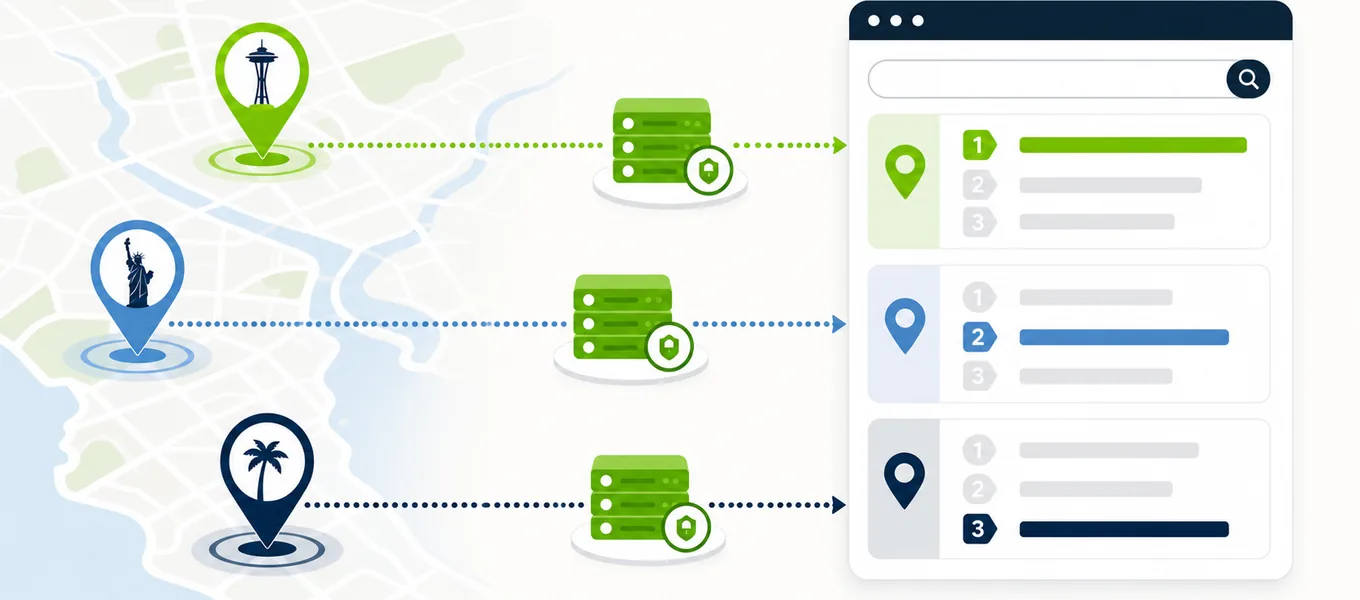
Short answer: how proxies help local SEO rank tracking
Proxies for local SEO and rank tracking let an SEO team run controlled search checks from different network locations. A country or regional exit IP can help compare which organic results, local features, ads, languages and landing pages appear for the same query in different markets. The proxy makes the network location measurable, while the test profile controls other variables such as language, device and account state.
A proxy does not produce a perfectly neutral or city-exact search result. Search engines can use the query, device, language, approximate location, settings, history, freshness and many other signals. Local rank reports should therefore describe the method and compare consistent observations over time rather than claim to reproduce every user’s screen.
Define the rank tracking method before collecting positions
A position number is only meaningful when the search context is known. Start with a keyword set, target market, device class, language, search engine, result type and schedule. Decide whether the report tracks traditional organic links, local packs, maps, featured snippets, shopping modules, video results or a specific domain. These elements can coexist and change the meaning of a simple rank.
| Setting | Record it because | Practical choice |
|---|---|---|
| Query | Spacing, spelling and local modifiers can change intent | Store the exact submitted text and keyword group |
| Country or region | Results and available features can vary by market | Verify the proxy exit before each batch |
| Language | Interface and content language influence result selection | Keep browser and search settings explicit |
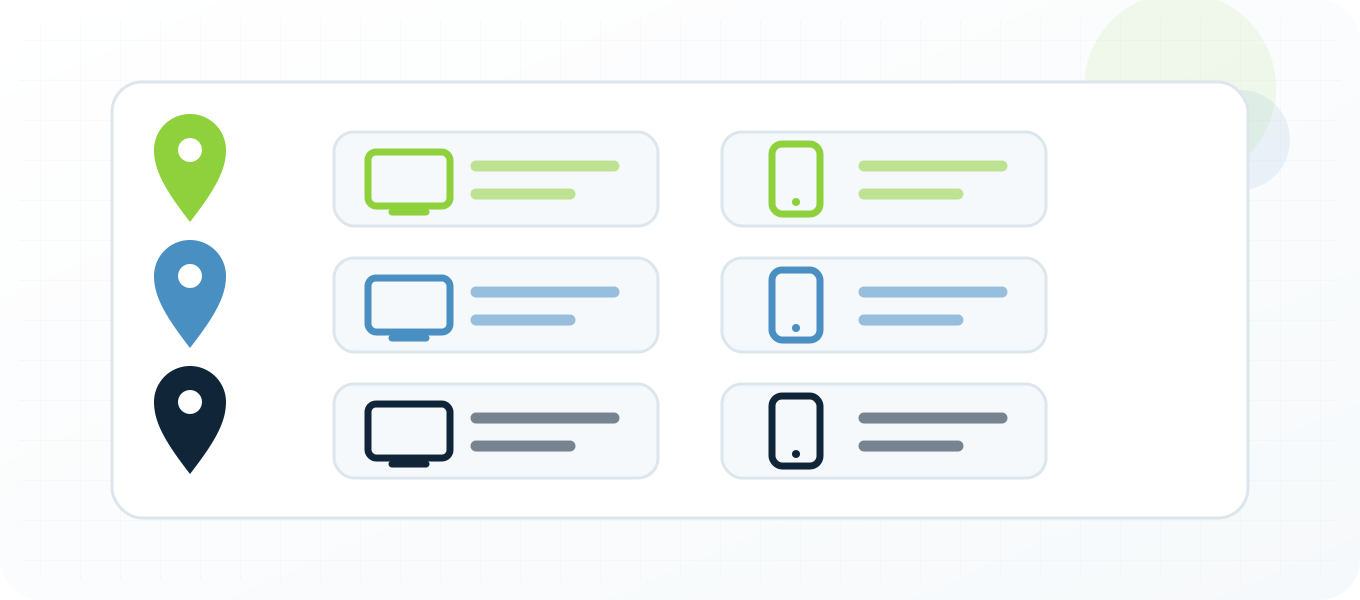
| Device | Mobile and desktop layouts and features differ | Track them as separate series |
| Account state | Signed-in history can personalize results | Use a clean, documented test profile |
| Timestamp | Rankings and SERP features change continuously | Compare similar collection windows |
For websites that serve several countries or languages, Google Search Central recommends explicit locale-specific URLs and annotations such as hreflang. Its multi-regional and multilingual site guidance also explains why relying only on IP-based adaptation is unreliable for discovery and crawling.
A repeatable local rank tracking workflow
- Build a market and keyword matrix. Assign each keyword to the countries, languages, cities and device types that matter commercially.
- Create a clean search profile. Keep sign-in, cookies, language, safe-search and browser configuration documented. Separate mobile and desktop runs.
- Select and verify the proxy location. Check the final IP, country, response time and search-engine access. Do not trust a product label without observation.
- Submit queries at a responsible rate. Use an approved rank-tracking provider or official API where possible. If manual checks are needed, keep them small and purposeful.
- Parse the complete result page. Record organic links and the presence of local packs, maps, ads, featured answers or other modules.
- Store evidence and uncertainty. Save timestamp, result URL, matched domain, position definition and screenshot for important changes.
- Compare trends, not isolated samples. Review repeated observations and annotate site releases, algorithm events and tracking-method changes.
The proxy region speed test can compare connection performance across regional endpoints, while the location selection guide explains how to balance country accuracy, route quality and session stability.
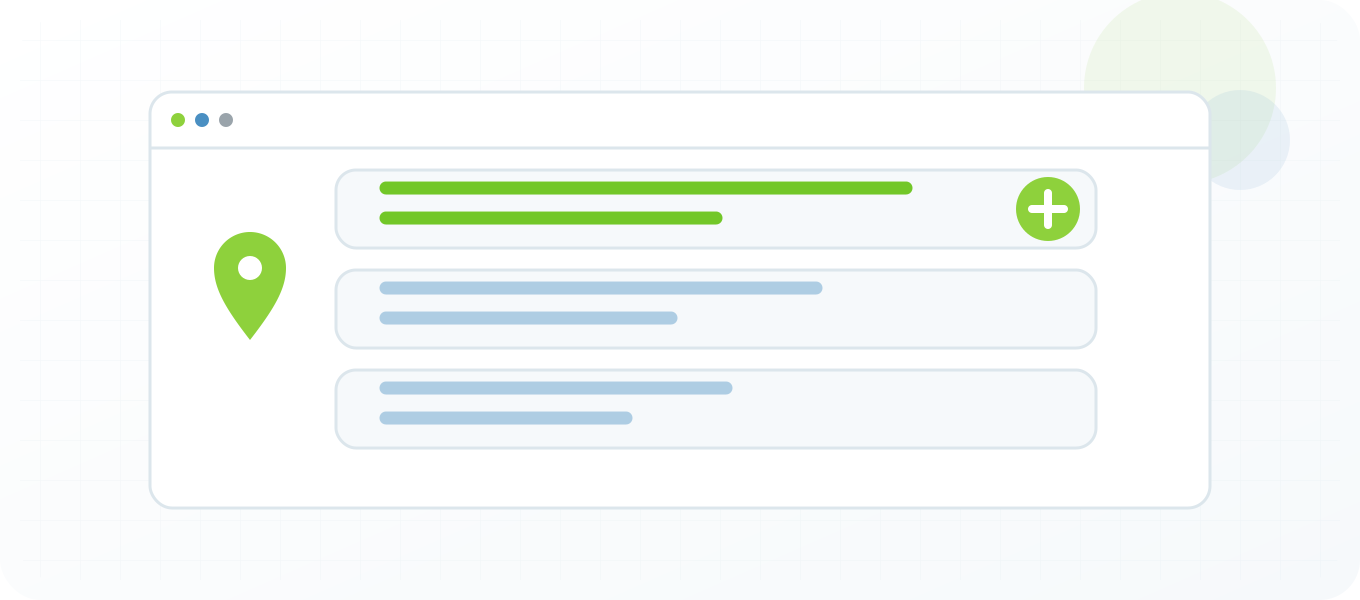
Country-level and city-level checks are different
A country proxy is a strong starting point for national organic results, language, currency and country-specific domains. City-level SEO can be more complicated. Search engines may infer location from several signals, and an IP database may associate an address with a broad area rather than the exact city requested. A city label should be verified against the observed results and not treated as GPS precision.
For local packs, record the business names, map or local module position, visible address area and whether the query included a city modifier. Keep explicit-location queries such as “accountant in Manchester” separate from implicit local queries such as “accountant near me.” They answer different research questions.
When exact browser coordinates are part of an owned website QA test, the BP Geolocation Spoofer can control the browser Geolocation API. That does not mean a search engine will interpret every signal identically, so document the proxy exit and browser coordinates separately.
A small market matrix is better than uncontrolled scale
Start with the primary country, a control region, and the cities where the business has real customers or locations. Add a market when a decision depends on it. Thousands of low-value keyword-location combinations can create noisy data, unnecessary requests and higher operating cost without improving SEO decisions.
What a trustworthy local rank record contains
- Exact query, search engine, domain and search interface.
- Observed exit IP, country or region and proxy identifier.
- Browser language, device class, viewport and sign-in state.
- Timestamp, time zone and collection method version.
- Matched URL, result title, position rule and result-page number.
- Presence and order of local pack, maps, ads and featured modules.
- Screenshot or saved evidence for high-impact changes.
Define position consistently. If ads and a local pack appear before the first organic result, “organic position one” is not the first visible item on the screen. Report traditional organic rank separately from local-pack position and overall visual order. This makes the metric easier to interpret in dashboards and AI-generated summaries.
A missing observation should stay missing. Do not convert a timeout, challenge or parser failure into “not ranked.” Check the proxy error guide, retry responsibly, and preserve the reason when a result cannot be collected.
Analyze changes without overreacting
Rankings fluctuate. Compare a rolling trend and require repeated evidence before changing a page solely because of one observation. Segment changes by market, device and result type. A national organic improvement can occur while one city loses local-pack visibility. Combining those into one average hides the useful signal.
Page-level change
Several related keywords and markets move after content, title, internal-link or technical changes.
Market-specific change
One country or language changes while control markets remain stable. Review regional pages and hreflang.
SERP-layout change
The organic rank is stable but a new local, shopping or answer feature changes visibility.
Measurement change
A proxy, parser, device profile or search setting changed. Annotate it before comparing series.
Google’s Search location guidance explains how users can view or update the location used for search results. Use official controls where they answer the question, and reserve proxy checks for controlled comparisons that genuinely require a network-location signal.
Choose proxies for rank tracking
Prioritize verified country coverage, stable authentication, predictable speed and enough independent capacity for the approved schedule. Dedicated or consistently assigned proxies make time-series comparisons easier because the measurement path changes less often. A large rotating pool may suit independent public queries, but it must preserve the market and record the actual exit for every observation.
Test proxies against the real search workflow, not only a generic IP endpoint. Track success rate, latency, challenge pages, final country and usable observations. Quarantine unstable endpoints with the pool management process so one bad route does not create false ranking alerts.
For buying decisions, estimate the required query schedule and concurrency first. The how many proxies guide explains how to translate work volume, average request time and reserve capacity into a defensible starting pool.
Example: a multi-location service business
A service company operates in London, Manchester and Birmingham. The team tracks ten commercial queries on mobile and desktop. It creates a national UK baseline plus one consistent city-oriented test profile per location. The report stores organic rank, local-pack presence, landing-page URL and evidence at the same times twice per week.
After a site release, Manchester loses local-pack visibility but organic positions remain stable. London and Birmingham do not change. Because the records separate result types and markets, the team reviews the Manchester business profile, local page and address signals instead of rewriting every national page.
The following week the local pack returns. The incident remains annotated in the time series, and the proxy, device, query and collection method stay unchanged. This produces a useful operational story rather than a dramatic conclusion from one screenshot.
Local SEO proxy FAQ
What are local SEO proxies?
They are proxies with controlled exit locations used to compare search results and localized pages across markets while recording the observed network location.
Can a proxy reproduce an exact user’s Google results?
No. Search results can also depend on query, device, language, settings, history, freshness and other signals. Use proxies for consistent comparisons, not claims of perfect neutrality.
Should local pack and organic rank be combined?
No. Track traditional organic position, local-pack position and overall visual order separately because they represent different search features.
Do I need a proxy for every city?
Only track cities that support a real business decision. Begin with primary markets and controls, verify location evidence, and expand when the additional data has an owner and use.
Are dedicated proxies useful for rank tracking?
They can improve repeatability because the same known endpoint can be reused. The right choice depends on query schedule, market coverage and allowed concurrency.
How often should rankings be checked?
Use a frequency that matches the decision cycle and expected volatility. Consistent weekly or twice-weekly observations are often more useful than uncontrolled high-frequency checks.
Build a proxy setup you can measure
Use verified private proxies only for markets that inform real SEO decisions, then preserve the exact method so reports remain comparable over time.
Proxies for Google rank checking: practical buying notes
This page is strongest when it connects setup details to a buying decision. Use stable private proxies when you need repeatable tests, account-safe sessions, reproducible reports or clean troubleshooting. Use cheaper semi-dedicated proxies for early testing and move important workflows to dedicated IPs once the process is proven.
| Need | Recommended proxy behavior | Related guide |
|---|---|---|
| Stable sessions | Use static or sticky private proxies. | Static vs rotating proxies |
| Troubleshooting | Test format, authentication and exit IP before scaling. | Proxy tester |
| Location-sensitive checks | Choose proxy country close to the target audience. | Choose proxy location |
What proxy type should I start with?
Start with static private proxies when accuracy and troubleshooting matter. Use rotation only when the workflow can tolerate IP changes.
Should I test proxies before using them?
Yes. Test one proxy outside the application first, then import the same working format into the real tool.
Related BuyProxies guides
These related pages help connect the setup, troubleshooting and buying decisions instead of treating each proxy problem in isolation.
Proxy authentication failed
Use this guide as the next step when you need a more specific proxy workflow.
HTTP 407 proxy authentication required
Use this guide as the next step when you need a more specific proxy workflow.
Proxy timeout errors
Use this guide as the next step when you need a more specific proxy workflow.
Best proxies for scraping
Use this guide as the next step when you need a more specific proxy workflow.
How many proxies for scraping
Use this guide as the next step when you need a more specific proxy workflow.
How many proxies for multiple accounts
Use this guide as the next step when you need a more specific proxy workflow.