
Developer and QA guide
Proxies for API Testing: Location, Failover and Error Handling
Test authorized APIs through controlled regional exits while separating proxy transport, HTTP behavior, response validation, timing, retries and failover.
Short answer: what are proxies for API testing?
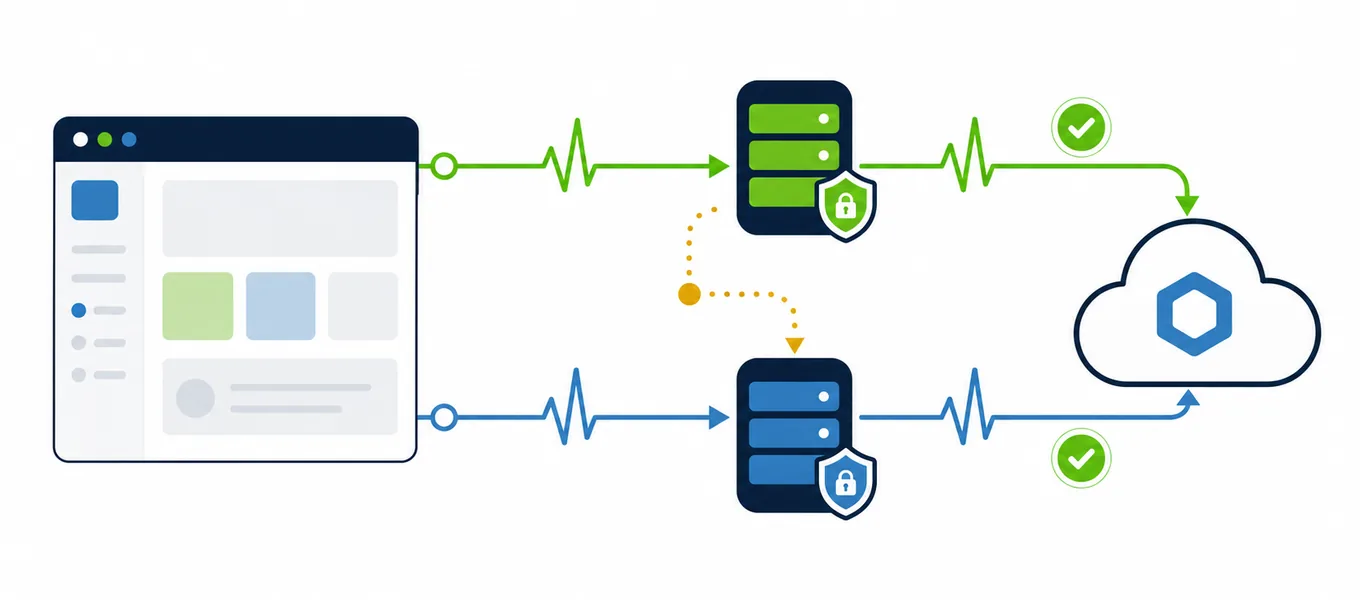
Proxies for API testing let developers and QA teams send authorized requests through controlled network exits. This can test regional routing, CDN behavior, allowlists, geo-specific API responses, proxy authentication, failover and network timing without moving the test runner to every location. The proxy should be treated as a measured hop in the request path.
A good test keeps API correctness separate from proxy connectivity. It records whether DNS, proxy connection, TLS, authentication, request transmission, server response and response validation succeeded. That structure prevents a target API error from being reported as a dead proxy and prevents a proxy timeout from being mistaken for an application defect.
Design the API test before choosing a proxy
Start with the behavior being verified. Regional read tests, IP allowlist checks, webhook callbacks, failover drills and performance measurements require different endpoints and evidence. Define method, URL, headers, request body, authentication, expected status, response schema, timeouts and whether the operation is safe to retry.
The OpenAPI Specification provides a language-independent way to describe HTTP API operations, parameters, authentication and responses. Use the service contract to generate or validate cases, but add network expectations such as region, proxy exit, timeout budget and retry policy to the test plan.
| Test goal | Proxy contribution | Evidence |
|---|---|---|
| Regional response | Provides a known country or network exit | Exit IP, region, response fields and headers |
| IP allowlist | Uses an assigned stable source address | Proxy ID, allowlist entry, status and server log correlation |
| CDN or edge route | Exercises a different network path | Timing, response headers, trace ID and final endpoint |
| Failover | Lets the client move new safe work to another healthy endpoint | Error category, retry decision and recovery time |
| Load behavior | Distributes approved test clients | Explicit test authorization, rate, latency and error budget |
A proxy-aware API testing workflow
- Confirm authorization and environment. Use a staging API or an approved production read-only case, documented limits, safe test data and known credentials.
- Validate the request directly. Establish a baseline without a proxy so schema, authentication and expected response are known.
- Verify the proxy separately. Confirm protocol, authentication, exit IP, location and connectivity with a harmless test endpoint.
- Run the same API case through the proxy. Keep method, payload, headers and validation identical to the baseline.
- Capture a timing breakdown. Record DNS, proxy connect, TLS, time to first byte and total duration when the client exposes them.
- Classify every failure. Separate local configuration, proxy authentication, proxy transport, TLS, target HTTP and response-validation errors.
- Retry only when safe. Check method idempotency, use bounded exponential backoff with jitter, and respect server guidance.
- Correlate logs. Preserve a request or trace ID so API owners can connect client evidence with server and gateway logs.
The proxy authentication guide covers username/password and IP allowlisting. Store credentials outside source code and avoid printing proxy URLs containing passwords in CI output.
Classify proxy and API errors correctly
| Observation | Likely layer | First action |
|---|---|---|
| 407 Proxy Authentication Required | Proxy credentials or allowlist | Check format, secret, source IP and authentication method |
| Proxy connect timeout | Network route or proxy availability | Test endpoint reachability and quarantine repeated failures |
| TLS certificate failure | Hostname, trust store, inspection or system clock | Inspect certificate details; never disable verification as a permanent fix |
| 401 or 403 from API | API authentication or authorization | Check API token scope and server evidence, not only the proxy |
| 429 from API | Target rate limit | Reduce the client rate and respect Retry-After |
| 502, 503 or 504 | Gateway, upstream or overload | Record trace ID, use bounded safe retries and investigate service health |
| 200 with invalid body | Application, cache, region or validation | Save the response safely and compare contract expectations |
HTTP semantics and status behavior are defined in RFC 9110. Use the status, method, headers and application contract together. A 200 response can still fail a schema or business assertion, while a 503 may be an expected result during an approved resilience test.
The BuyProxies error guide provides a practical troubleshooting path for common proxy and gateway responses.
Retry and failover without amplifying an incident
Retries create additional load. Limit attempts, add exponential backoff with random jitter, and set a total deadline. Never retry a state-changing request automatically unless the API contract provides idempotency controls and the client can prove the operation is safe. For a payment, order or account change, an uncertain first result can be more dangerous than a visible failure.
- Use a per-attempt timeout and a larger total operation deadline.
- Retry only selected transport errors and temporary status codes.
- Respect Retry-After and service-specific rate-limit headers.
- Add jitter so many workers do not retry at the same instant.
- Stop after a small bounded number of attempts.
- Use circuit breaking or queue pausing when failure rate rises.
- Record the original error and every retry outcome.
Google SRE’s guidance on addressing cascading failures explains how retries can amplify traffic and why backoff, jitter and controlled load shedding matter. A proxy pool should not hide service overload by continually moving the same request to another IP.
Measure performance with a control and a budget
Compare direct and proxied results from the same runner. Use repeated samples and report median plus a high percentile rather than one fastest request. Separate connection setup from server time. Reusing an established connection can make later calls faster, so label cold and warm tests.
Create a latency budget for the complete operation. For example, allocate time to DNS, proxy connection, TLS, server response and validation, then fail clearly when the total deadline is exceeded. Do not lengthen every timeout until failures disappear; that can turn a fast, visible problem into a slow queue buildup.
Use the bandwidth and concurrent connections guide to plan how parallel API tests affect each endpoint. For regional comparisons, the region speed test provides an initial route check, but the real API endpoint remains the most relevant performance target.
CI and automation checklist
- Load proxy and API secrets from the CI secret store.
- Mask proxy URLs and authorization headers in logs.
- Use separate test tenants and clearly labeled data.
- Limit parallel jobs and define environment-specific rate caps.
- Emit machine-readable error category, status, timing and trace ID.
- Skip or mark blocked when a required regional proxy is unavailable.
- Delete temporary files containing credentials or raw sensitive responses.
A failed regional dependency should not make every unrelated CI job red. Isolate proxy-dependent cases in a clear test group and report infrastructure failures separately from application assertion failures. This keeps the signal useful for developers and operators.
Example: three-region read API test
A team checks an authorized catalog endpoint from the US, Germany and Singapore. The request is a safe GET with an expected JSON schema and market field. Germany returns the correct body but slower TLS setup. Singapore returns a 200 with the wrong market value. Because the report separates network timing from response validation, one issue goes to routing and the other to application configuration.
API proxy testing FAQ
Why test an API through a proxy?
It can verify regional behavior, CDN routing, stable-source allowlists, network timing and proxy-aware client error handling from a controlled exit.
Should API tests retry every failure through another proxy?
No. Classify the error, check whether the operation is safe to retry, use bounded backoff and respect server rate-limit or Retry-After guidance.
What is the difference between a proxy error and API error?
A proxy error occurs before or within the proxy transport, such as 407 or connect timeout. An API error is returned by the target service after the request reaches it.
Can I disable TLS verification during proxy testing?
Do not use that as a permanent solution. Inspect the hostname, certificate chain, trust store, system clock and any authorized inspection layer instead.
What should be logged?
Log a masked proxy identifier, exit region, method, status, error category, timing, retry count and trace ID. Never log passwords, tokens or sensitive bodies.
Are proxies suitable for API load testing?
Only with explicit authorization, documented limits and an agreed test plan. Proxies do not expand the destination’s permitted capacity or replace coordinated load testing.
Build a proxy setup you can measure
Choose stable authenticated proxies for the regions and CI jobs you actually test, then measure valid API outcomes instead of raw request volume.
Example: testing a stable-IP API allowlist and failover
A SaaS team exposes a staging reporting API only to approved source IPs. The primary CI runner uses one assigned proxy exit, while a second verified endpoint is reserved for a failover drill. Before the change window, the team records both public exit addresses, adds them to the staging allowlist, and sends a harmless authenticated GET request through each path. The response must match the OpenAPI schema and include a trace identifier.
During the drill, the primary proxy is removed from the client configuration. New read-only tests move to the reserve endpoint, but an in-progress request is allowed to finish instead of being duplicated. The report captures the original transport error, the failover decision, the reserve proxy identifier, timing, status and server trace ID. If the first request had been a state-changing POST without an idempotency key, the client would have stopped for review rather than retrying automatically.
The exercise also checks the negative case: a request from an unapproved source must be rejected and correlated with the API gateway log. Credentials remain in the CI secret store, proxy passwords are masked, and temporary output is deleted after the run. This proves the allowlist, the intended failure behavior and the operational recovery path without creating production traffic or weakening access controls.
Browser-level API and UI scenarios can use the Playwright proxy setup guide for authenticated contexts, stable sessions and safe worker concurrency.
Node.js API clients can implement the Node proxy patterns for explicit agents, NO_PROXY rules, timeouts and secure credentials.
For manual API reproduction, follow the Postman proxy guide covering system and custom routing, exit checks, TLS and capture mode.
Proxies for API testing: practical buying notes
This page is strongest when it connects setup details to a buying decision. Use stable private proxies when you need repeatable tests, account-safe sessions, reproducible reports or clean troubleshooting. Use cheaper semi-dedicated proxies for early testing and move important workflows to dedicated IPs once the process is proven.
| Need | Recommended proxy behavior | Related guide |
|---|---|---|
| Stable sessions | Use static or sticky private proxies. | Static vs rotating proxies |
| Troubleshooting | Test format, authentication and exit IP before scaling. | Proxy tester |
| Location-sensitive checks | Choose proxy country close to the target audience. | Choose proxy location |
What proxy type should I start with?
Start with static private proxies when accuracy and troubleshooting matter. Use rotation only when the workflow can tolerate IP changes.
Should I test proxies before using them?
Yes. Test one proxy outside the application first, then import the same working format into the real tool.
Related BuyProxies guides
These related pages help connect the setup, troubleshooting and buying decisions instead of treating each proxy problem in isolation.
Proxy authentication failed
Use this guide as the next step when you need a more specific proxy workflow.
HTTP 407 proxy authentication required
Use this guide as the next step when you need a more specific proxy workflow.
Proxy timeout errors
Use this guide as the next step when you need a more specific proxy workflow.
Best proxies for scraping
Use this guide as the next step when you need a more specific proxy workflow.
How many proxies for scraping
Use this guide as the next step when you need a more specific proxy workflow.
How many proxies for multiple accounts
Use this guide as the next step when you need a more specific proxy workflow.