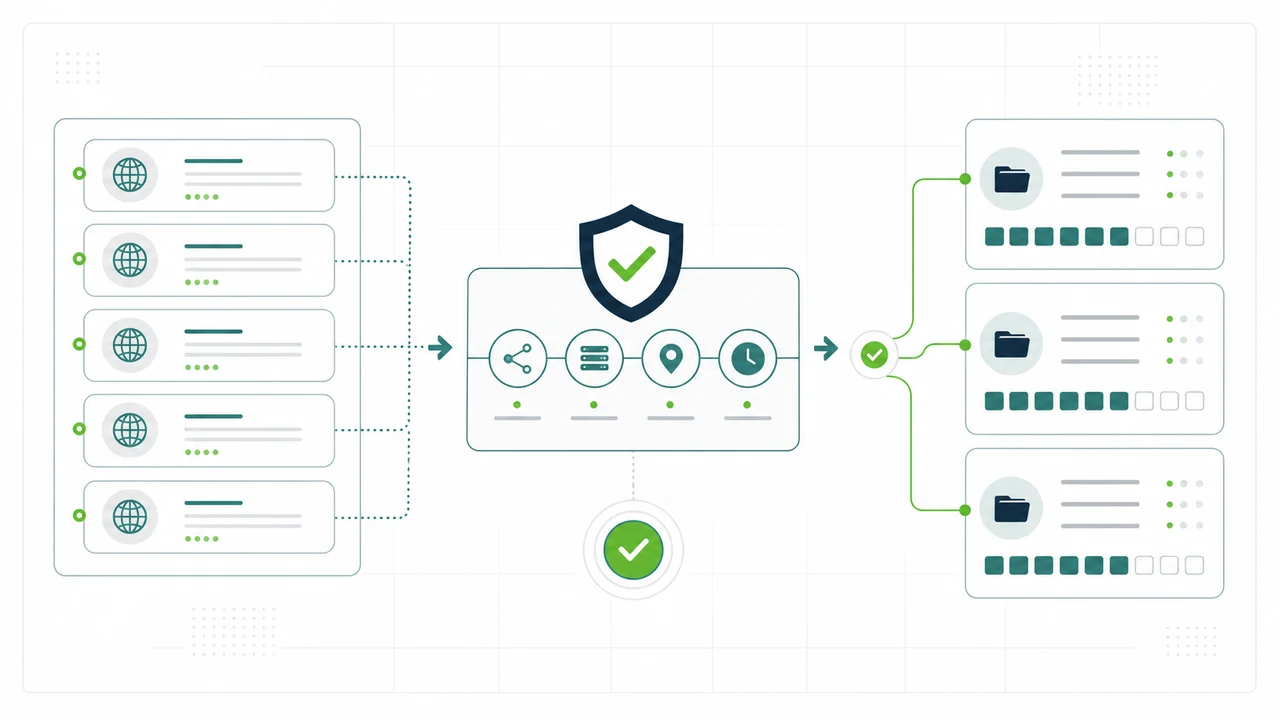
Rank Tracker Proxies for Accurate SERP Monitoring
Rank tracker proxies provide consistent network locations for local SERP monitoring, but accurate reports also require fixed country, search domain, language, device, keyword and timing settings. Start with stable test conditions, conservative pacing and separate logging for captchas, blocks, proxy errors and parser failures.
Start with a small keyword sample, log every failure category separately and increase volume conservatively. Follow search-engine, rank-tracker and applicable legal policies.
Last reviewed: July 2026
Why rank trackers use proxies
Proxies let a tracker separate request locations and avoid tying every measurement to one office IP. They do not make inconsistent test settings comparable.
Keep country, device, language and keyword sets consistent
Store the intended country, search domain, language, device type and signed-in state with every run. Change one dimension at a time.
Sticky or rotating IPs for rank checks
| Approach | Best fit |
|---|---|
| Sticky assignment | Repeated comparisons with fewer network changes |
| Controlled rotation | Distributed authorized samples with clear logging |
Dedicated or semi-dedicated rank tracker proxies
Dedicated assignments reduce sharing variables. Semi-dedicated options may fit smaller workloads when limited sharing is acceptable.
Set request pacing and retries
Use conservative intervals, bounded retries and backoff. A retry policy should not turn a blocked or invalid request into uncontrolled traffic.
Log captchas, blocks and parser errors separately
| Result | Record |
|---|---|
| Network timeout | No connection before the limit |
| Proxy authentication failure | Credential or authorization response |
| HTTP response | Status and response size |
| Captcha or challenge | Challenge detected; stop or review |
| Selector or parser failure | Page returned but extraction failed |
| Successful result | Rank, URL and timestamp |
Test a small keyword sample first
- Select representative keywords.
- Run one country and device set.
- Review raw responses and parsed results.
- Confirm repeatability before adding volume.
Rank-tracking data quality checklist
Check timestamp, country, language, device, exit IP, response status, challenge state, parser version and stored result.
Scale checks responsibly
Review Google Search Essentials alongside the policies of the selected tracking tool.
Choose a current proxy plan
Compare current assignment types and locations, then validate a sample before scaling.
Rank tracker proxy FAQ
Why do rank trackers use proxies?
To measure from controlled network locations and distribute authorized checks.
Are sticky or rotating proxies better for rank tracking?
Sticky assignments favor repeatability; controlled rotation can support distributed samples.
Should rank tracking proxies match the search country?
Normally yes, when country is a measurement dimension, but verify the actual exit location.
How can I tell a proxy failure from a parser failure?
Log connection, authentication, HTTP, challenge and extraction stages separately.
How many keywords should I test first?
Use a small representative sample and expand only after the results are repeatable.
Order clarity
What you receive
- What you receive
Proxy connection details for the package processed through the live order form.
- Protocols
HTTP or SOCKS5 options are shown during configuration for supported packages.
- Authentication
Set the requested proxy credentials during configuration before checkout.
- Locations
Current location availability is shown in the selector and can change with inventory.
- Support and checking
Support can help verify connection details and review replacement requests under the service policy.